
TODO
Household Management App
Role
End-to-end UX/UI
Research
Visual & Branding
Project Type
Personal Project
Year
2023
Tools
Figma
Adobe Illustrator
Jump to Solution
The Problem
Mental Load and Unshared Responsibility.
Managing household routines can become complex when schedules, tasks, emotional dynamics, and coordination all fall on one person. For families with children, this often means parents carry much of the invisible work themselves.
Existing apps cover the basics, but often fall short in flexibility, personalization, and engagement for real family routines. Tasks remain fragmented, motivation drops, and children are often left out of the process.
This revealed a clear need for a system that brings clarity, collaboration, and shared ownership into daily household management.
The Challenge
Designing Structure Without losing Flexibility.
The main challenge was to translate the chaotic, emotionally charged reality of household management into a structured system - without making it feel rigid or overwhelming.
Because families with children introduced the highest level of complexity, I used them as the primary design focus: parents needed visibility and guidance, while children needed a simple, motivating way to participate.
This required designing for uneven motivation levels, shared responsibility, and everyday routines - without increasing friction.
User Research Intro
Understanding Household Routines Across Different Types of Homes.
To understand how household responsibilities are managed in real life, I began by looking at different household structures - including couples, roommates, and families.
The goal was to understand how tasks are divided, how responsibility is shared, and where household management starts to break down.
This broad research approach helped identify where the problem was most complex, and where the product could create the most meaningful impact.
User Survey
Mapping How Different Households Share the Load.
To gather initial insights, I conducted a short survey with 57 respondents managing daily household routines, including parents, couples, and shared households.
The survey explored how responsibilities are divided, how mental load is experienced, and how tasks are tracked and completed.
Across household types, one pattern stood out: household work was often unevenly distributed, managed by one primary person, and harder to share when children were involved.
90%
said household tasks are not equally divided.
77%
reported being the primary person managing the home.
64%
said children are not actively involved in household tasks.
User Interviews
Families With Children Revealed the Deepest Layer of Complexity.
While the survey showed that household task management was relevant across different living arrangements, families with children revealed the deepest layer of complexity.
To better understand these challenges, I conducted 5 one-on-one interviews with parents managing household routines, primarily those with young children.
The interviews revealed that household management was not only about dividing responsibilities. Parents also struggled with motivating children, guiding participation, tracking progress, and creating shared ownership - without turning routines into conflict.
Invisible coordination
Mental load
Parents described the constant work of remembering, assigning, reminding, and
following up.
Motivation without conflict
Behavioral challenge
Many parents struggled to encourage kids without turning tasks into arguments.
Need for shared visibility
UX need
Parents wanted a clearer way to show who is responsible for what, what was completed, and what still needs attention.
Balance between structure and flexibility
Design tension
Families needed enough structure to stay aligned, but not a system that felt rigid or controlling.
“I want them to feel responsible, instead of waiting to be told what to do”
Neta, Parent of Three
User Research Insights
By combining survey data with one-on-one interviews, I identified three recurring gaps in how families manage household tasks.
The research showed that household work often remains invisible, responsibility is unevenly distributed, and children are frequently left outside the process - creating a need for clearer ownership, visibility, and participation.
01
Mental load is unseen and uneven
02
Kids are left out of the process
03
Competitive Analysis
Following the user research, I looked at family-oriented household apps to understand how existing products translate shared responsibility into actual UX.
I analyzed Cozi, OurHome, FamilyWall, and S’moresUp across task logic, roles, personalization, collaboration, and child engagement.
The goal was to identify where current tools support family coordination - and where they fall short in creating ownership, motivation, and meaningful participation.

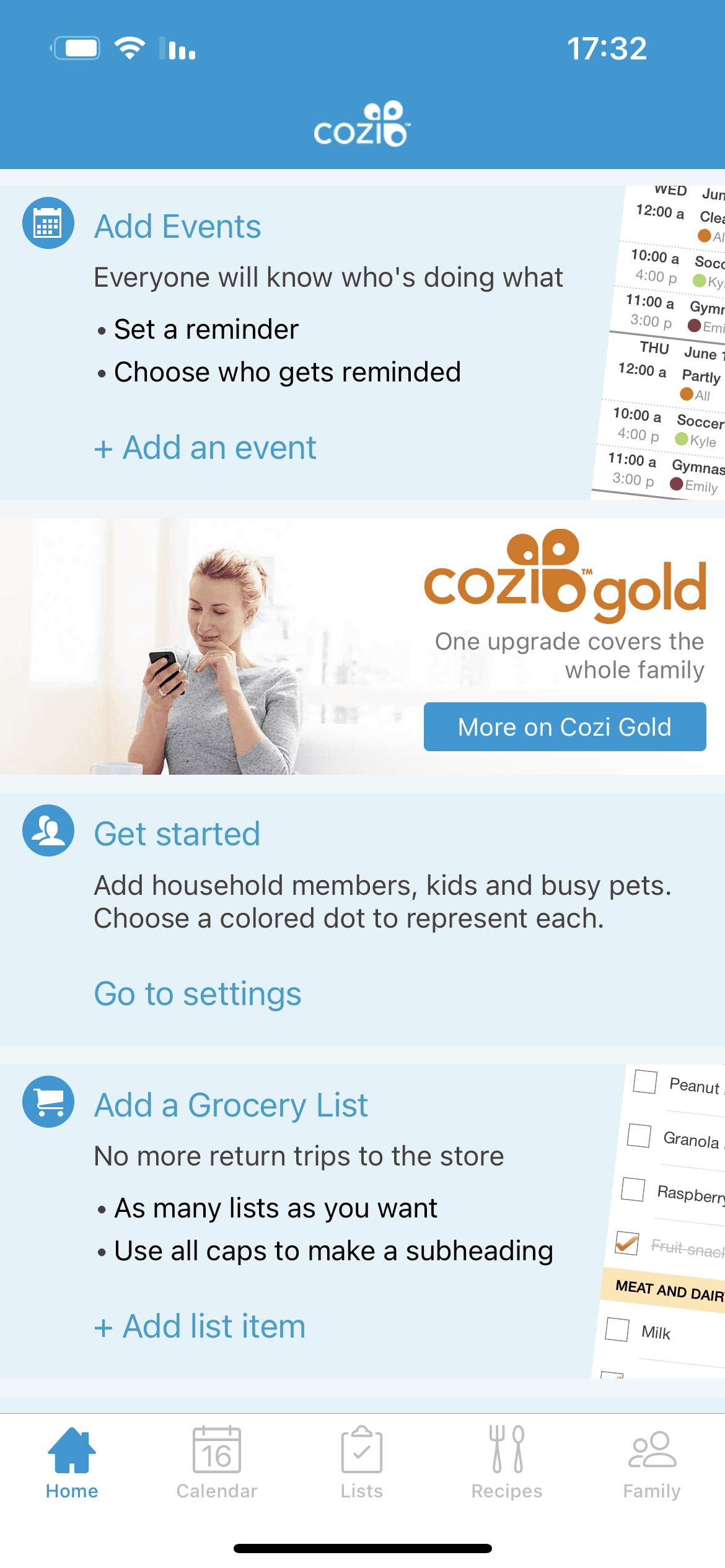
Competitive Insights
My competitive analysis revealed recurring UX patterns, content gaps, and missed opportunities across four household management apps.
While most tools supported task assignment and basic organization, they often fell short in creating shared responsibility, meaningful child participation, and flexibility for different family structures.
01
Shared tasks ≠ Shared responsibility
Most apps enable task assignment - but do little to promote true collaboration or emotional ownership.
02
Kids are treated like end users, not team players
Competitors design for children, but rarely with them in mind - leaving little room for autonomy, input, or feedback.
03
One size doesn’t fit all families
Most apps assume a single family model, offering limited flexibility for diverse roles and routines.
Product Strategy
After synthesizing the research findings and market analysis, I translated the core challenges into six design principles.
Together, these principles shaped a product direction focused on shared responsibility, child participation, flexible family structures, and parent visibility - without turning support into micromanagement.
Design with kids in mind through gamification, challenges, and progress tracking that support autonomy and consistent engagement.
Allow flexibility in group setup, role customization, and permissions to fit different household compositions and routines.
Provide clear visual tools, categories, and templates to make complex, recurring, or multi-step tasks easy to organize and track.
Design Concepts
After defining the design principles, I translated them into a visual framework. The wireframes focused on simplifying task management, visualizing family structure, and turning abstract user needs into clear product flows.
I tested three layout directions to find the right balance between structure, visibility, and engagement.
Each direction tested a different balance between clarity, motivation, and family collaboration.
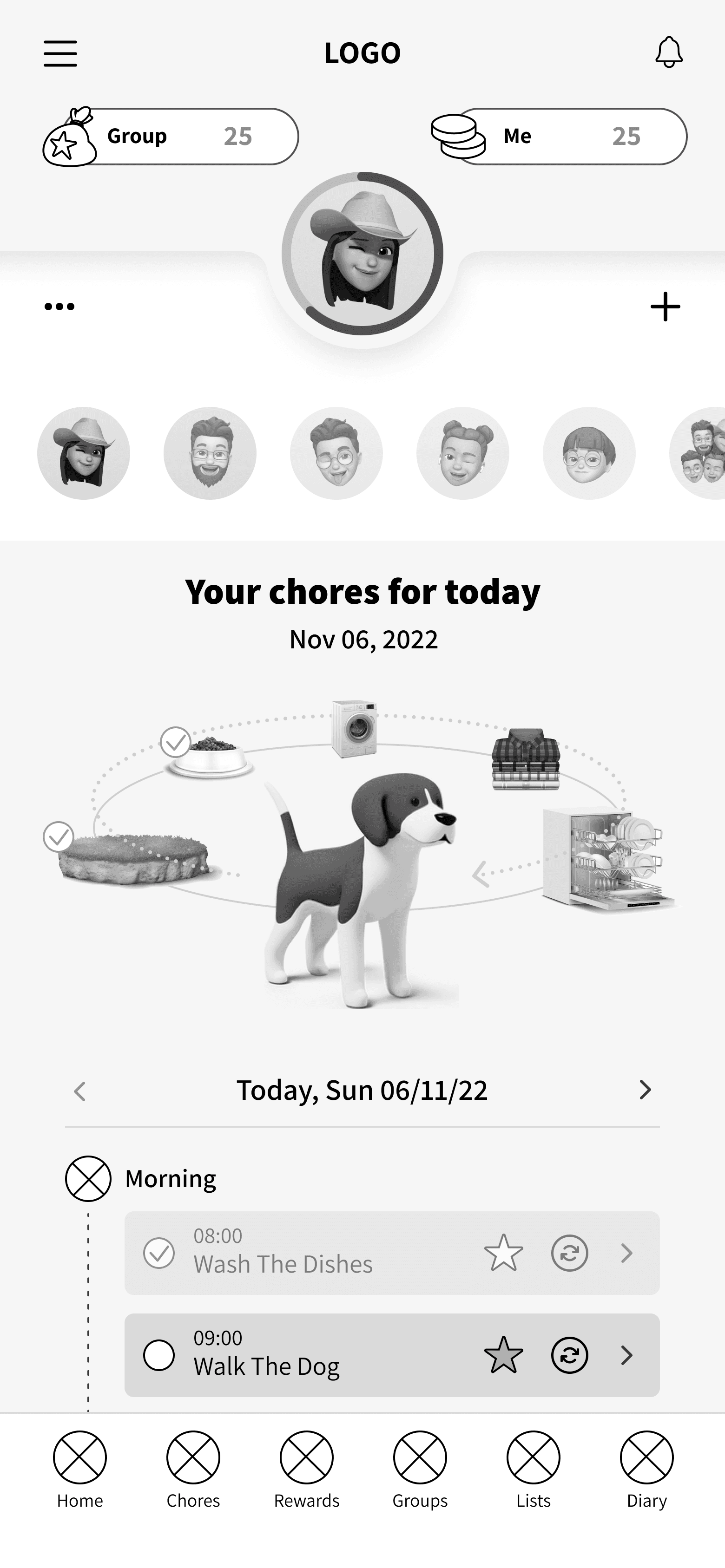


Selected Direction
Option A was selected as the foundation for the final design because it created the strongest balance between structure, visibility, and engagement.
It supported quick scanning of daily tasks, made family progress feel visible, and introduced gamified motivation without overwhelming the core task-management experience.
Design Solution
The final design turns the research findings into a household task-management experience built around visibility, shared ownership, and motivation.
Todo combines personalization, family roles, progress feedback, rewards, and selected AI-supported moments to help families manage routines together.
The broader product concept includes both parent and child experiences.
This prototype focuses on the core parent-side flows, where household members, tasks, rewards, and progress are managed.
From setup to shared household
A lightweight setup flow that helps families define their household structure, create a personal profile, generate an avatar, and invite members.
It turns registration into the foundation for a shared, personalized experience.
Managing the household from one
shared view
A shared home view that makes household members, progress, coins, and daily tasks visible in one place - while allowing parents to add and manage members as routine evolve.
Turning tasks into shared actions
This flow balances structure and flexibility by letting users choose between a Personalized Task for quick setup or a Custom Task for specific household needs.
When conflicts appear, the system suggests task swaps to reduce manual coordination and keep responsibility shared.
Turning progress into motivation
The rewards flow turns task completion into visible progress through coins, goals, playful feedback, and reward approval.
It helps motivate participation over time while giving parents a clear way to track and reinforce follow-through.
Outcome
This project showed that household management is not just about completing tasks - it is about the dynamics between the people who share them.
Through research, testing, and iteration, it became clear that families need more than organization. They need visibility, ownership, and simple ways to involve children in everyday responsibilities.
The final solution combines structure with motivation, helping make responsibilities clearer, participation more consistent, and everyday routines feel more collaborative.