
ODDITY
Il Makiage
Role
End-to-end UX/UI
Research
Visual & Branding
Project Type
E-Commerce
Team
1 Product Manager
2 Developers
Tools
Figma
Adobe Illustrator
Adobe PS
Jump to Solution
The Problem
The Product Detail Pages (PDPs) represented the brand’s second-highest revenue flow, with a large share of traffic coming from organic and returning users with strong purchase intent. Yet the experience was outdated, created friction at key decision points, and had one of the lowest AOVs among the main purchase flows.
New users needed more reassurance and guidance, while returning customers needed a faster, more efficient path to purchase. This created an opportunity to reduce uncertainty, improve conversion, and unlock more value from the existing traffic.
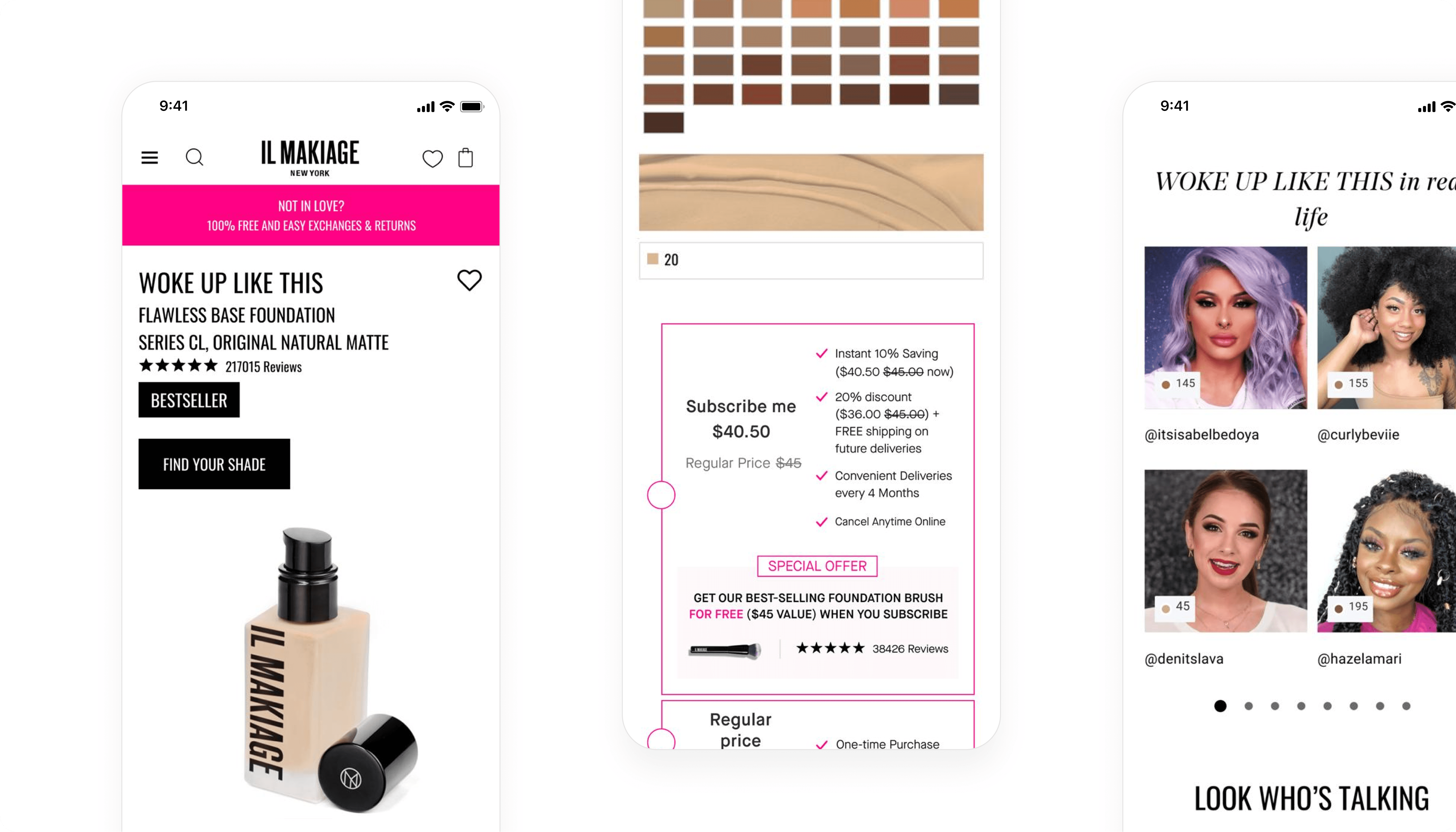
Woke Up Like This Foundation old PDP
The Challenge
As the lead designer on the PDP redesign, my challenge was to unlock more value from the existing PDP traffic by increasing Revenue Per User (RPU), using Conversion Rate (CR) and Average Order Value (AOV) as the two main business levers.
Beyond the UX/UI overhaul, this project introduced a new approach to user research.
We had never conducted structured user testing before, so I had to quickly learn how to gather insights, analyze behaviors, and translate them into actionable design decisions.
Research Approach
Rather than relying solely on analytics, I needed to understand what happened between product interest and purchase hesitation.
To uncover the real friction points, I combined quantitative and qualitative research - using surveys, interviews, and competitive analysis to learn how users evaluate products, what builds their confidence, and where the PDP experience failed to support their decision.
User Survey
To reach a relevant, high-quality audience for the interview phase, I led a short user survey as part of the research process.
The survey included 8 simple questions about the shopping experience on the site and was intentionally distributed to gather initial signals from real customers.
A total of 118 users responded, most of them aged 26–35, helping us identify early patterns and select the right participants for deeper interviews.

The survey we sent to our customers
User Interviews
The survey revealed broad patterns around foundation purchases, reviews, and shade uncertainty. To understand the reasons behind these patterns, I followed up with in-depth interviews with selected participants.
During the sessions, I observed users navigating the Il Makiage website in real time, paying close attention not only to what they said, but also to how they reacted, hesitated, and made decisions.
We interviewed 10 active female users, aged 27–41, all based in the United States. Each had previously completed the survey and was either a current or potential customer.

In-depth interviews with users
The interviews added behavioral context to the survey responses.
By watching users navigate the site in real time, we saw how uncertainty appeared during the purchase journey - especially around trust, shade selection, and product understanding.
Users paused around reviews and real-user photos.
Users hesitated when comparing shades.
Users looked for clearer explanations around application, coverage, and expected results.
User Research Insights
Combining the survey results with the interview observations, it became clear that users were not only looking for more product information - they needed more confidence before making a purchase.
01
Users Seek Visual Validation
02
Shade Selection Lacks Clarity
03
Competitive Analysis
After identifying confidence as the biggest barrier in the user research, I analyzed leading beauty and e-commerce brands to understand how successful product pages help users make purchase decisions.
I reviewed over 15 products across multiple websites, focusing on features that reduce uncertainty, improve product understanding, and build trust throughout the purchase journey.
From this analysis, I selected three standout products that introduced different approaches to helping users feel more confident before buying, directly influencing my design decisions.
Fenty Beauty is a beauty industry brand with inclusive range of products for all skin tones.
Advanced review filtering - Users can filter reviews by skin tone and concerns.
Shade finder tool - Fenty highlights the option to choose the right shade.
Product comparison feature - Makes it easier to compare similar items.
Overloaded UI - High contrast and bold design may create visual clutter.
Inconsistent navigation flow - Some product pages require too many steps to reach key information.
Complex product pages - Too many features may lead to decision fatigue.


Rhode is a skincare brand focused on clean, simple, and hydrating products.
How-to-use" video - Enhances product understanding and user confidence.
Routine bundles - Encourages higher order value through smart bundling.
Clear Product Benefits - Highlights key advantages upfront.
Lack of urgency - Minimalist approach reduces conversion-driving elements.
Limited interactivity - No quizzes or strong personalization features.
Basic review filtering - Less advanced compared to Fenty.
Apple is a global tech leader creating a seamless ecosystem for users.
Structured product comparison - Side-by-side comparisons make decision-making easier.
Clear CTAs - Well-placed buttons guide users effectively through the buying process.
Seamless navigation - Intuitive flow ensures users find what they need quickly.
Overly structured layout - Can feel rigid and less adaptable for exploratory shopping.
Lack of storytelling - Minimal emotional engagement compared to lifestyle-driven brands.
High information density - Some pages present too much data at once, potentially overwhelming users.

Competitive Insights
Successful product pages did more than present product details - they translated information into tools that helped users compare, evaluate, and move forward with greater clarity. These patterns directly informed the final design.
01
Simplified Decision-Making
Clear comparisons, smart filtering, and structured product info help users choose with confidence.
02
Build Trust Through Personalization
Tools like quizzes, shade finders, and user-generated content boost trust and engagement.
03
Guide Users Toward Purchase
Intuitive navigation, clear CTAs, and a balanced layout reduce friction and drive sales.
Product Strategy
After synthesizing the user research and competitive analysis, I translated the key insights into a design strategy focused on helping users make more confident purchase decisions.
Together, these strategic directions shifted the product page beyond presenting product information - toward guiding users through evaluation, comparison, and decision-making.

Start by redesigning shade products, which are the most purchased and often the most confusing for users, especially the Foundation.

Incorporate real-user reviews with images, shade previews on diverse skin tones, and rich visual content to support trust and clarity.

Integrate simple, visual usage instructions, especially for technical products like foundation - to support proper application.
Provide structured product information, clear comparisons, and smart filtering - helping users evaluate options quickly and accurately.

New users needed reassurance; returning customers could move more directly to purchase. Keep confidence tools accessible while bringing key purchase options closer.
Design Exploration
Since the Foundation PDP represented a high-impact opportunity, I used the Woke Up Like This Foundation as the starting point for the redesign.
Based on the design strategy, I created two low-fidelity concepts to explore different approaches to product hierarchy, information structure, and purchase flow.
Both concepts were tested in production. After a gradual rollout to confirm stability, traffic was split 50/50 and the test ran for approximately one month.
Version A / Product Confidence First
Kept the hero product as the primary decision, while introducing confidence-building features and a focused bundle opportunity.
Version B / Bundle-Led Growth
Surfaced bundles earlier in the journey to test whether high-intent users would discover more products and increase Average Order Value.


Selected Direction
Version A outperformed the alternative and became the foundation for the final design.
The results showed that keeping the hero product as the primary decision point performed better than surfacing bundles earlier, supporting a clearer purchase journey before introducing complementary recommendations.
Design Solution
The final design focused on reducing uncertainty at every stage of the purchase journey, helping users choose, understand, and validate products with confidence.
Building Confidence From the First Screen
Research showed that shade selection was a key point of hesitation.
The redesigned header combines personalized shade guidance, quick selection, and direct access to the shade quiz in a more compact layout - reducing uncertainty while shortening the path to purchase.
The tighter hierarchy also brings subscription higher in the journey without turning the first screen into a hard sell.
Supporting Better Product Understanding
The page restructures product information around the questions users need answered before purchasing -
from benefits, ingredients, and finish comparisons to usage guidance and complementary bundles - while keeping the shade quiz accessible for users who need additional reassurance.
Building Trust Through Authentic Content
Users relied on real customer experiences before purchasing.
The redesign highlights authentic reviews, customer photos, product benefits, and visual guidance to strengthen trust and reduce uncertainty.
Helping Users Find Relevant Reviews
Instead of browsing hundreds of reviews, users can filter feedback by shade, skin tone, undertone, and rating to quickly find experiences that match their own.
Impact
Following the month-long test, Version A outperformed both the alternative and the legacy experience. The redesign improved conversion and Foundation sales, validating a product-first hierarchy before introducing complementary offers.
Conversion Rate improved versus the legacy PDP.
Foundation sales increased following the rollout.
Beyond the initial launch, the redesign established a design direction for shade-based best sellers. Following the success of the Foundation PDP, selected principles and components were adapted to the Concealer PDP, allowing the learnings to scale beyond a single product.